Decision Tree

Decision Tree

Decision Tree Jonathan Poland

A decision tree is a graphical representation of a decision-making process. It is a flowchart-like structure that shows the various possible outcomes of a decision, along with the probabilities and costs associated with each outcome. Decision trees are often used in the field of management science and operations research, as they provide a visual representation of the costs, benefits, and risks associated with different decisions.

Here is an example of a simple decision tree:
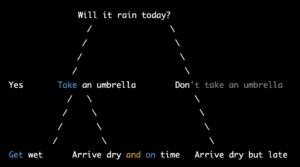
In this example, the decision tree shows the different outcomes of the decision to take an umbrella based on whether it rains or not. If it rains and the decision is made to take an umbrella, the individual will arrive dry and on time. If it does not rain, the individual will arrive dry but may be late. If the decision is made not to take an umbrella and it rains, the individual will get wet.

Decision trees can also be used to analyze more complex decisions, such as whether to invest in a new product or expand a business into a new market. In these cases, the tree may have multiple branches and may consider a wider range of factors, such as the potential return on investment, the likelihood of success, and the risks involved.

Decision trees are useful because they provide a structured way to think through a decision and consider all of the possible outcomes. They can help decision-makers to weigh the costs, benefits, and risks of different options and choose the one that is most likely to be successful.

In conclusion, decision trees are a powerful tool for decision-making that can help individuals and organizations to evaluate the potential outcomes of different choices and make informed decisions based on data and analysis.

Phased Implementation Jonathan Poland

Phased Implementation

Phased implementation is a method of developing and introducing a business, brand, product, service, process, capability, or system by dividing…

Procurement Risk Jonathan Poland

Procurement Risk

Procurement risk is the risk of financial loss or other negative consequences that may arise from the process of procuring…

Volatility Risk Jonathan Poland

Volatility Risk

Volatility risk is the possibility that changes in the volatility of a risk factor will lead to losses. Volatility is…

Buying Behavior Jonathan Poland

Buying Behavior

Buying behavior refers to the actions and decisions made by consumers when purchasing goods or services. These are relevant to…

Political Risk Jonathan Poland

Political Risk

Political risk refers to the potential for losses or other negative impacts on an organization as a result of changes…

Remarketing Jonathan Poland

Remarketing

Remarketing is a marketing strategy that involves targeting customers who have previously interacted with a business. This is often done…

What is Competitive Parity? Jonathan Poland

What is Competitive Parity?

Competitive parity is a marketing strategy that involves matching or aligning a company’s marketing mix with that of its competitors.…

Product Diffusion Jonathan Poland

Product Diffusion

Product diffusion refers to the process by which a product or service is accepted and adopted by a target market.…

Cross Merchandising Jonathan Poland

Cross Merchandising

Cross merchandising is a retail strategy that involves placing related or complementary products in close proximity to each other in…

Learn More

Business Management Jonathan Poland

Business Management

Business management is the process of overseeing and running a business or organization. This involves a wide range of activities,…

Compliance Risk Jonathan Poland

Compliance Risk

Compliance risk refers to the risk that an organization may face as a result of not complying with laws, regulations,…

Overthinking Jonathan Poland

Overthinking

Overthinking, also known as rumination, is a thought process that involves excessive and prolonged contemplation of a problem or situation.…

What is Marketability? Jonathan Poland

What is Marketability?

The marketability of a brand, product, or service refers to its competitiveness within a market. It is the likelihood that…

Big Picture Thinking Jonathan Poland

Big Picture Thinking

“The big picture” refers to the broadest possible perspective that can be taken in a thought process. Big picture thinking…

What is Fandom? Jonathan Poland

What is Fandom?

Fandom refers to the subculture that develops around particular popular culture series or formats, such as films, television shows, characters,…

Innovation Risk Jonathan Poland

Innovation Risk

Innovation is a proactive approach to business and design that aims to make significant improvements, rather than simply making incremental…

What is Moral Hazard? Jonathan Poland

What is Moral Hazard?

Moral hazard is a term used in economics to describe a situation in which one party has less incentive to…

Taxes Jonathan Poland

Taxes

Taxes are mandatory financial contributions that are levied by a government on individuals, businesses, and other organizations. The money collected…