strategy

Decision Framing

Decision Framing Jonathan Poland

Decision framing refers to the way in which a choice or dilemma is presented or structured. This includes the language used to describe the options, the context in which the decision is made, and any additional information that is provided. Decision framing can be used to influence the decision-making process and the choices that are made. It can also be used to improve the quality of decisions by providing decision-makers with the necessary information and context to make informed choices. The following are common types of decision framing.

Preserving Ambiguity

Preserving ambiguity is the idea that a decision statement be as wide open as possible in order to allow for creative decisions. This principle can be applied throughout the decision making process to avoid imposing assumptions and constraints too early. For example, a decision statement such as “what type of park should we create?” assumes that a particular area will become a park. A statement such as “what type of public space should we create?” leaves open more possibilities.

Creativity of Constraints

Creativity of constraints is the idea that well designed initial constraints can improve creativity and efficiency. For example, a decision statement such as “how should I get an education without paying any tuition?” is far more difficult to answer than “where should I go to university?” As such, the more constrained decision statement requires more creative alternatives. Constraints can be added and removed from a decision statement to generate alternatives. For example, “what university program should I choose with the constraint that it needs to pay for itself with higher salary prospects within 5 years?”

Positive Framing

Framing a decision in an optimistic light. For example, “what steps should we take to delight every customer?”

Negative Framing

Framing a decision in an pessimistic light. For example, “what should we do to prevent customer defections given that our products are lower quality than the competition?”

Overcomplexity

A decision that is framed with complex language and structure such that a regular person has trouble understanding it. For example, a legal agreement for software that needs to be accepted by every user that contains complexities that only a lawyer would fully understand.

Choice Architecture

Breaking a decision into a series of successive choices with a structure. Often used to influence. For example, a marketing page for a bicycle may begin by asking you to select a color and then proceed to selecting a model and options. This can result in escalating commitment on the part of the customer.

False Dichotomy

A false dichotomy is an incorrect assertion that a decision is between two alternatives when more options exist. For example, do we want to compete on price or quality?

False Alternative

Misrepresenting an alternative. For example:
Do you want to subscribe to our investing newsletter?
✓ Yes ✘ I want to invest recklessly without being informed

Decoy Framing

Placing an obvious bad choice in a list of alternatives. This is commonly done in price lists. When customers see that one price is better than the others they may feel an impulse to buy.
Ice Cream Cones
1 cone – $3
2 cones – $8
5 cones – $10
Decision Tree

Decision Tree Jonathan Poland

A decision tree is a graphical representation of a decision-making process. It is a flowchart-like structure that shows the various possible outcomes of a decision, along with the probabilities and costs associated with each outcome. Decision trees are often used in the field of management science and operations research, as they provide a visual representation of the costs, benefits, and risks associated with different decisions.

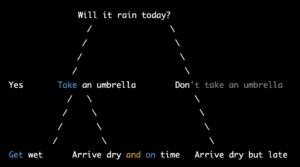
Here is an example of a simple decision tree:

In this example, the decision tree shows the different outcomes of the decision to take an umbrella based on whether it rains or not. If it rains and the decision is made to take an umbrella, the individual will arrive dry and on time. If it does not rain, the individual will arrive dry but may be late. If the decision is made not to take an umbrella and it rains, the individual will get wet.

Decision trees can also be used to analyze more complex decisions, such as whether to invest in a new product or expand a business into a new market. In these cases, the tree may have multiple branches and may consider a wider range of factors, such as the potential return on investment, the likelihood of success, and the risks involved.

Decision trees are useful because they provide a structured way to think through a decision and consider all of the possible outcomes. They can help decision-makers to weigh the costs, benefits, and risks of different options and choose the one that is most likely to be successful.

In conclusion, decision trees are a powerful tool for decision-making that can help individuals and organizations to evaluate the potential outcomes of different choices and make informed decisions based on data and analysis.

What is Big Data?

What is Big Data? Jonathan Poland

Big data refers to extremely large and complex datasets that are difficult to process using traditional data processing tools. These datasets often come from a variety of sources, such as social media, sensors, and transactional data, and can contain both structured and unstructured data. The volume, variety, and velocity of big data can make it challenging to extract value from it. However, with the right tools and techniques, organizations can use big data to gain insights and make better decisions.

One key aspect of big data is the ability to process and analyze it in real-time, also known as stream processing. This enables organizations to quickly respond to changing conditions and make decisions based on the most up-to-date information. Big data can be used in a variety of industries, including healthcare, finance, and retail. For example, in healthcare, big data can be used to improve patient care by analyzing patient data to identify trends and patterns that can help predict future health issues. In finance, big data can be used to identify fraudulent activity and improve risk management. In retail, big data can be used to optimize pricing and inventory management.

There are several tools and technologies available for processing and analyzing big data, including Hadoop, Spark, and NoSQL databases. These tools enable organizations to store, process, and analyze large volumes of data quickly and efficiently. Basically, big data refers to extremely large and complex datasets that can be challenging to process using traditional tools. By using the right tools and techniques, organizations can extract valuable insights from big data and use it to make better decisions.

Qualitative Data

Qualitative Data Jonathan Poland

Qualitative data refers to information that is expressed in a language such as English and cannot be easily quantified or measured. It is often contrasted with quantitative data, which can be represented numerically and is more easily processed by machines. While qualitative data may provide deeper insights and context, it is more difficult to analyze and requires advanced techniques such as artificial intelligence for natural language processing. Currently, most qualitative data is generated by humans, but it is possible that machines may eventually be able to express complex ideas with words as well.

The following are common examples of qualitative data.

  • Strategy – A company executive expresses a company’s strategy in words.
  • Designs – An architect describes a concept for a building to a client.
  • Communication – A stock analyst advises an investor on a private call.
  • Stories – A firm builds an extremely valuable brand by telling stories that people find compelling.
  • Comments & Feedback – A new game is released and people who try it post their feelings and ideas about it.
  • Guides – A guide describes how to write code in a particular programming language.
  • Knowledge- A physicist explains a new theory with a short analogy. The theory goes on to change our understanding of the universe and has countless applications for engineering and technology.

Basis of Estimate

Basis of Estimate Jonathan Poland

A basis of estimate (BOE) is a document that outlines the methodology and assumptions used to create an estimate for a project. It is typically used to provide a detailed explanation of how the estimate was developed, and to provide transparency and accountability for the estimate.

The BOE should include a description of the work that is being estimated, as well as the assumptions and constraints that were considered in developing the estimate. This may include information about the resources that will be required, the schedule for the work, and any other factors that could impact the cost or duration of the project.

In addition to providing a detailed explanation of the estimate, the BOE may also include supporting documentation, such as cost estimates for materials or labor, or references to industry standards or best practices that were used to develop the estimate.

The BOE is an important tool for managing projects, as it helps to ensure that the estimate is accurate and transparent. It is also useful for stakeholders, as it provides them with a clear understanding of the assumptions and constraints that were considered in developing the estimate, and helps to build confidence in the accuracy of the estimate. The following are examples of basis of estimate content.

Assumptions & Constraints

Any assumptions and constraints that were required to generate a set of estimates. This isn’t a repeat of project assumptions but applies to the estimates themselves. For example, assumptions that were made to generate a list of comparable projects for estimate benchmarks.

Attachments

Identify the version of requirements, risk registers and other project artifacts that are the basis of the estimate. Attach any source documents such as price quotes from suppliers.

Estimate Summary

A high level summary designed to communicate the estimate to all stakeholders such that it can be easily understood.

Procedure

A description of the estimation procedure. For example, describing a bottom-up estimation process of identifying tasks and having subject matter experts estimate each. Include details of calculations or algorithms.

Guidelines

Principles that are used to guide estimates. For example, a principle of using three point estimates to estimate complex tasks.

Bottom-up Estimates

If bottom-up estimates are used the details are included at the level at which estimates were produced, typically the task level.

Parametric Estimates

The details of any calculations or algorithms that were used to generate estimates. Algorithms are sufficiently explained in plain language such that they aren’t a mystery.

Analogous Estimates

Any comparisons that were used to generate or validate estimates based on your historical projects. The details of the historical projects used are listed.

Reference Class Forecasting

Any benchmarks that were used to generate or validate estimates using a database of similar programs, projects and initiatives. The details of relevant database entries are listed.

Third Party Estimates

Details of price quotations and other estimates provided by third parties.

Contingency

Details of contingency added to an estimate to account for risk. Potentially includes confidence intervals for estimates.

Analysis

Details of any analysis related to the estimates.

Validations

Details of sanity checks and validations that were performed. For example, a bottom-up estimate technique that is validated with reference class forecasting.

Approvals

An audit trail of approvals for the estimate.

Project Stakeholder

Project Stakeholder Jonathan Poland

A stakeholder is anyone or any group that is impacted by a project. This includes individuals or teams who are accountable for or responsible for certain aspects of the project, as well as stakeholders who are simply consulted or kept informed about the project. The following are a few common types of stakeholders:

Project Sponsor

The persons accountable and responsible for representing the sponsoring business.

Customer or Client

Representatives from the sponsoring business who have a stake or role in the project such as providing requirements.

Program Management

A project may fall under a program or impact programs.

Project Management

Managers of the project or projects that are related or impacted.

Business Analysts

Business analysts deliver artifacts such as the project’s business case or requirements.

Project Team

Generally defined as anyone who contributes work to the project.

Project Management Office

An organization’s Project Management Office may have interest in project in order to monitor a project portfolio or maintain project management standards.

Project Management Board

Project governance bodies such as a Project Management Board.

Executive Team

Generally a project wants to garner as much executive attention as possible in order to create visibility that helps to clear issues and recognize project successes.

Functional Managers

Managers who are impacted by business change driven by a project or who have resources committed to the project.

Architects & Designers

Members of the project team who are responsible for delivering aspects of the project’s architecture and design.

Internal Stakeholders

A term for stakeholders who work for the client organization.

External Stakeholders

External stakeholders include anyone involved in a project who doesn’t work for the client organization such as contractors, vendors, partners and suppliers.

End Customers

The customers of the project’s sponsoring business unit.

Local Communities

In many cases, members of the local community have stake in a project. For example, the neighbors of a large construction site may be impacted and compensated for disruption to their use or enjoyment of their property. In such cases, they may be informed of project schedule updates.

Regulators

Some projects attract the interest of government agencies who become stakeholders. In many cases, government approvals are a project dependency.

Request for Proposal

Request for Proposal Jonathan Poland

An RFP (request for proposal) is a document that asks suppliers to provide a detailed proposal for a supply contract. This could include materials, parts, components, services, and outsourcing partners. When issuing an RFP, it is often because the company wants to consider more than just price in awarding the contract. For example, a technology project might also consider factors such as technical capabilities, reputation, and the vendor’s ability to deliver. The following is a template that can be used as a starting point for an RFP bid.

Purpose

Describe what you want and why.

Background

Provide the context for the request.

Scope of Work

A list of requirements. This may include functional requirements and non-functional requirements. These may be presented in a variety of formats such as user stories or specifications. Each requirement is designed to be atomic, correct, verifiable, unambiguous, complete and consistent.

Performance Standards

State your expectations for supplier performance and how performance will be monitored and controlled.

Deliverables

State what the supplier will deliver.

Deliverable Quality

A list of acceptance criteria for deliverables.

Commercial Terms

State the proposed legal terms of the contract.

Payments, Incentives & Penalties

Give details of how payments, incentives and penalties will be assessed and paid.

RFP Requirements

A specification of what RFP responses must include. For example, it is common to request that suppliers describe in detail how they will achieve each requirement in the statement of work. Other requirements may include a detailed price quotation, company profile, references and elements of a solution design and a solution architecture. RFP requirements may link to other templates that must be filled out and attached to responses such as a template for software architecture.

Award Process

Describe how RFP responses will be evaluated and the contract awarded.

Schedule

Define a schedule including deadlines for anything you expect from suppliers.

Contacts

A list of contacts for the RFP process.

Management Levels

Management Levels Jonathan Poland

A management level is a layer of accountability and responsibility in an organization. It is common for organizations to have up to three management levels. The levels are typically referred to as top-level management, middle-level management, and lower-level management.

  1. Top-level management: Top-level management, also known as strategic-level management or senior management, refers to the highest level of management in an organization. This level includes the chief executive officer (CEO), the chief financial officer (CFO), and other top executives. Top-level management is responsible for setting the overall strategy and direction of the organization and making high-level decisions.
  2. Middle-level management: Middle-level management, also known as operational-level management, refers to the level of management that is responsible for implementing the strategies and plans developed by top-level management. This level includes managers who are responsible for overseeing the day-to-day operations of the organization and making decisions that impact the immediate work environment.
  3. Lower-level management: Lower-level management, also known as front-line management, refers to the level of management that is responsible for supervising and coordinating the work of front-line employees. This level includes supervisors, team leaders, and other managers who are responsible for overseeing the work of individual employees and ensuring that tasks are completed efficiently and effectively.

Strategic Partnership

Strategic Partnership Jonathan Poland

A strategic partnership is a relationship between two or more organizations that is characterized by mutual cooperation and the sharing of resources in order to achieve common goals and objectives. Strategic partnerships are often formed in order to achieve competitive advantage, gain access to new markets or technologies, or share risk and cost.

There are several key factors that are important to consider when establishing a strategic partnership. These include:

  1. Alignment of goals and values: It is important that the goals and values of the partnering organizations are aligned in order to ensure that the partnership is successful. This may involve identifying shared goals and objectives, as well as identifying areas of potential collaboration and cooperation.
  2. Synergies: Strategic partnerships can be successful when the partnering organizations have complementary strengths and resources that can be leveraged to create value. For example, if one organization has strong marketing capabilities and another has a strong product development team, the two organizations may be able to work together to create innovative new products and bring them to market more effectively.
  3. Communication and transparency: Effective communication and transparency are critical to the success of a strategic partnership. It is important for the partnering organizations to be open and transparent with each other and to establish clear lines of communication in order to ensure that the partnership is effective.
  4. Governance: It is important to establish clear governance structures and processes in order to ensure that the strategic partnership is effective. This may involve establishing committees or other decision-making bodies, as well as defining roles and responsibilities within the partnership.

Overall, strategic partnerships can be an effective way for organizations to achieve common goals and objectives and create value. By considering these key factors and establishing strong governance structures and processes, organizations can ensure that their strategic partnerships are successful. The following are common types of strategic partnership.

Research & Development

Join programs of innovation and product development. For example, solar companies that invest in a development project for more durable solar cells that can be used as roads.

Design

Design partnerships such as a small design firm that partners with a large established manufacturer on a line of shoe designs. This gives the small firm access to efficient manufacturing and extensive marketing capabilities. The large firm benefits from fresh designs from a growing firm that has demonstrated its ability to design for certain target markets.

Supply

Suppliers such as a strategic supply of a material that is in high demand such that shortages are likely.

Outsourcing

Outsourcing non-core business activities in order to focus on areas of competitive advantage. For example, a real estate company that outsources its information technology functions.

Supply Chain

Supply chain partners such as a web based company that develops partners with supermarkets and convenience stores to act as pickup points for packages.

Distribution

Distribution agreements such as a retailer that agrees to sell your products in its stores.

Value Added Resellers

A partner that adds services or additional product features to your offerings before reselling them. For example, a partner that sells your software product as a service.

Promotion

Promotional partners such as a beverage company that partners with a summer music festival to promote its brand.

Branding

Brand partnerships such as a cobranded product.

Projects

Funding a shared program or project. For example, a partnership of IT firms that funds a new internet backbone that benefits both companies.

Sustainability

A commercial entity that partners with a non-profit to improve communities or the environment. For example, a fast food restaurant that funds an ocean plastic clean up initiative.

Brand Image Jonathan Poland

Brand Image

Brand image is the overall perception that consumers and the public have of a brand. It is the way that…

Brand Awareness Jonathan Poland

Brand Awareness

Brand awareness refers to the extent to which consumers are familiar with and able to recognize a brand. It is…

Perfect Competition Jonathan Poland

Perfect Competition

Perfect competition is a theoretical market structure in which a large number of buyers and sellers participate and no single…

Business Management Jonathan Poland

Business Management

Business management is the process of overseeing and running a business or organization. This involves a wide range of activities,…

Ideation Jonathan Poland

Ideation

Ideation is the process of generating ideas and solutions to problems. It is a crucial step in the creative process,…

Product Management Jonathan Poland

Product Management

Product management is the practice of managing a portfolio of products throughout their lifecycle from concept to end-of-life. It can…

Bankability Jonathan Poland

Bankability

Bankability is a term used to describe the ability of a project or venture to secure financing from a lender…

Change Driver Jonathan Poland

Change Driver

A change driver is a force or factor that initiates or drives change within an organization. Change drivers can be…

Razor and Blades Jonathan Poland

Razor and Blades

The razor and blades model, also known as the bait and hook model, is a business strategy that involves selling…

Learn More

Balance Sheet Jonathan Poland

Balance Sheet

The balance sheet is a financial statement that provides a snapshot of a company’s financial position at a specific point…

Cost Benefit Analysis Jonathan Poland

Cost Benefit Analysis

Cost-benefit analysis (CBA) is a systematic approach to evaluating the costs and benefits of a project, program, or policy to…

Organizational Capital Jonathan Poland

Organizational Capital

Organizational capital refers to the intangible assets and resources within an organization that support its operations and enable it to…

Strategic Thinking Jonathan Poland

Strategic Thinking

Strategic thinking is the process of considering the long-term direction and needs of an organization, and developing plans and strategies…

Market Position Jonathan Poland

Market Position

The market position of a brand, product, or service refers to its place in a crowded market. It is the…

Thought Process Jonathan Poland

Thought Process

Thought is the mental process of perceiving, organizing, and interpreting information. It is the foundation of all higher cognitive functions,…

Employee Retention Jonathan Poland

Employee Retention

Employee retention refers to the success of a company in keeping its talented employees from leaving. High employee turnover can…

What is a Capitalist? Jonathan Poland

What is a Capitalist?

A capitalist is an individual who supports or practices capitalism, which is an economic system based on the principles of…

Forward Thinking Jonathan Poland

Forward Thinking

Forward thinking is the ability to anticipate and prepare for future events and trends in order to make informed and…